
Asphalt crack sealing in Montreal
- Registered Quebec business (NEQ)
- Fully insured
- 5 years in business
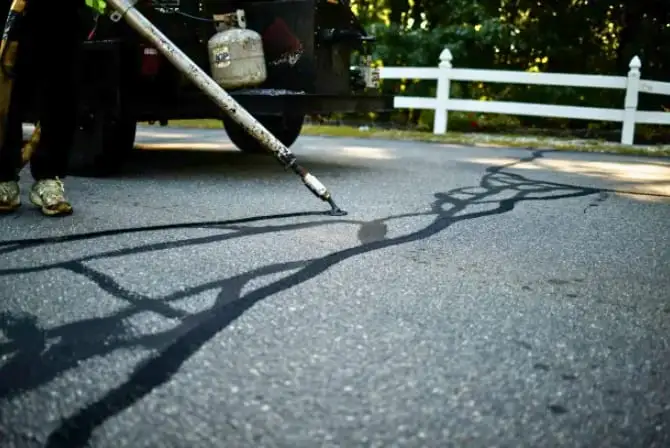
Why seal cracks before winter
A crack looks harmless in July. By April it can be a pothole. Montreal gets dozens of freeze and thaw cycles every year, and each one works water a little deeper into the asphalt.
Frost pushes cracks wider
Water runs into a crack, freezes and expands. Every winter the crack gets wider and deeper.
The base goes soft
Once water reaches the gravel under the asphalt, the base weakens and the surface starts to sink and break apart.
Small jobs stay small
Sealing a crack costs a fraction of patching a pothole or repaving a driveway later.
Crack sealing or crack filling?
You'll hear both terms. Crack filling usually means pouring a filler into cracks that don't move much. Crack sealing uses a flexible, rubberized sealant for cracks that open and close as the ground freezes and thaws.
Most driveway cracks in Montreal move with the seasons, so a flexible sealant tends to hold up better than basic driveway crack filling. We look at your cracks first and use what fits.
How we seal cracks
- 1
Clean
We blow out dirt, weeds and loose stones so the sealant sticks to clean asphalt.
- 2
Dry
Sealant only bonds to dry asphalt, so we work on dry days.
- 3
Seal
Each crack gets filled with sealant and smoothed level with the surface.
- 4
Set
The sealant sets quickly. We'll tell you when you can drive on it again.
Which cracks can be sealed?
Most single cracks up to about 2 cm (¾ inch) wide are good candidates. Wider cracks may need to be filled in stages.
If you see a web of small connected cracks, often called alligator cracking, the base underneath has failed. Sealing won't hold there. That area needs asphalt repair first.
Seal the cracks, then the driveway
Crack sealing and driveway sealcoating work best together: we seal the cracks first, then coat the whole surface so it sheds water and looks new. The same goes for parking lot sealcoating.
The price depends on how much cracking there is and how wide the cracks are. See typical driveway sealcoating prices, or request a quote and we'll give you an exact number.
Crack sealing questions
When is the best time to seal cracks?
Any dry day from late spring to fall. Sealing in the fall, before the first freeze, protects the driveway through the winter.
How long does crack sealing last?
Usually a few years. Asphalt keeps moving, so new cracks can show up over time. A quick check every year or two keeps them under control.
Can you seal cracks without sealcoating the whole driveway?
Yes. Crack sealing is its own job, and lots of people do it between sealcoats. If you want both, we seal the cracks first and coat the driveway after.
Will the sealed cracks show?
Yes, the sealant leaves dark lines where the cracks were. If you sealcoat afterwards, the whole surface ends up one even colour. See driveway sealcoating.
Related services
- Driveway sealcoatingA fresh coat of sealer keeps out water, road salt and sun, and brings back a deep black finish.Learn more →
- Asphalt repairPotholes, sunken spots and crumbling edges patched, so the surface is solid before it gets sealed.Learn more →
- Parking lot sealcoatingCleaning, crack filling and sealcoating for commercial and residential parking lots.Learn more →